My name is Erin Shuman. I am an art student at the University of Illinois. This interview was granted as part of a study project of local artists using various mediums. Here’s my interview with Phil in May of 2019
The process for creating these cards is multi-fold.
The creative side requires a background in and passion for collecting. As an avid collector for the past four decades, Phil Apostle has built complete sets from 1952-1958 and from 1976-1989 including a PSA Set Registry Award for his 1977 Topps set (the first year he purchased packs from the drugstores). What followed were collections of alternate poses and team affiliations featured in the 1977 O-PEE-CHEE set and, later, homemade cards of various rookies and stars. A musician and writer, he spent 30 years in professional baseball, first as a player, then in player development, scouting and coaching. When he’s not on the field, he’s creating his “virtual artifacts of Americana”. Originally, he began his project to spend less time on the field and at his Academy to be home with his four children. A single Dad with four teen-agers, the “Fab Five”, as they call themselves, are tighter than most. They travel, eat and socialize with one another every day. As we talk, his kids are watching “American Dad” , playing with the dogs outside— while one plays an expert guitar that I thought was a Guns N’ Roses album from an upstairs bedroom.
ES: So, you’re a single Dad. You are raising four kids alone and you work crazy hours. Honestly, it seems impossible. How do you balance?
PA: “I never think about it like that. We get out of balance like everyone else. I’m a happy and mellow person—very simple to please. My kids are my posse and I just put them first. They’re my joy. We just…ya know…live and enjoy each other. There are challenges, of course, but everybody is pretty easy going. Simple understandings help avoid conflicts. If you can’t get along with your family— what chance do you have out there (laughs). I want my kids to pursue their minds vision. School has it’s place but nobody ever created anything by doing what they’re told. If they do their best toward anything gainful, I’m on board. Baseball, Tae Kwon Do, Badminton, Guitar…whatever it is. That’s the stuff that truly builds and if you share in it—it binds. We’re tightly bound.”
ES: I am fascinated with what would inspire you to delve this deeply into your subjects. What drove you to this level?
PA: “Not sure. It wasn't really boredom. It was actually the desire to see and...experience, if you will, MORE! I love the cards of my youth. But after you've seen 'em thousands of times; it's nice to see the "what ifs'…I have a very active imagination. Very. Always have.” (laughs)
ES: What, exactly, is ‘Banty Red’?
PA: “…Well, I’m ‘Banty’, the love of my life was a fiery redhead. I’ll also say I enjoyed my Red Man. Still do! My imaginary tobacco tastes just like it." (Laughs). There’s really not anything else to it. The names of some sets are ale’s I’ve made at various places. They’re all terrible. The ingredients seem like they’d be good—but I’ll stick to the cards.”
The practical side of the process begins with an image. Phil sold much of his baseball card collection to purchase large inventories of original negatives and to acquire various licenses. His stash of negatives is truly unbelievable. They’re barely organized. Binders, boxes, archival trays and large cabinets custom made for storage. His own estimate is 200 thousand. It looks like much more. His prized possession is a hoard of original Charles Conlon negatives he won in an auction in 1998.
ES: Tell me about the negatives. Where did they come from?
PA: “They come from all over the world—as far away as Japan. My best Ruth came from Japan! Most are regional photographers of teams. These wonderful photographers are mostly anonymous guys that teams hire and freelance for magazines like Sporting News, Illustrated and such. The Conlons are my babies. 400 of them. Cost me a lung but I love them and my kids get it all when I’m gone.”
ES: Not trying to be too personal but, what kind of money is that?
PA: “ A helluva lot more than I had” ((laughing and loading a nicotine pouch)
ES: “I’m sure. How did you get them?”
PA: “Hard to fathom—I didn’t even know it—seriously, I had $300,000 in baseball cards. I figured I had about 80-100 grand and it was my retirement. I made a decision that was tough. You know, parting with the cards, but what I really love about cards, at the end of the day, is the art and the image...the way it presents. That drives me more than anything technical. Either it looks cool and appeals to you or it doesn't. This gave me an opportunity to actually DO something. I saw it as a great opportunity to connect with what I consider the core of collecting. Very few collectors can afford a good-looking, authentic, in-period Cobb. I set out to make one they’d be proud to own."
ES: Obviously, the collectors like what you do. Have you ‘connected’ with many?
PA: “A few. I actually look at my collectors like family. People say that, but I’m a softie and get sentimental pretty easily. So, I truly mean it. I’ve started making cards that certain guys will like. The auction style allows them to bid according to their tastes. The funny thing is how some guys hate me and what I do so much it drives them to some level of derangement. They view it as some kind of assault on ‘their hobby’. Hey, I’m in that hobby! If you don’t like them, don’t bid. The hatred is hard to wrap my head around.” (gets visibly uncomfortable)…
ES: I don’t understand. Explain?
PA: “Things like chatboards. You find the real gems of the universe on those things. They worry about restitution on behalf of the players I paint, ask about licensing, say I’m being deceptive—my best evidence of emotional problems. It’s negative so I choose to just leave it. Many of these fellows would have to give a credit card number to even speak to a woman like you. Some are fabulous, but we tend to remember the bad ones—human nature. I just stay away and work for my collectors. They drive me to do better. I want Monday night to be an event for them. Something exciting. Like collecting was for me. I’m done there…let’s talk more about the process.”
ES: Within the process, do you limit yourself in any way? I know artists—including me— that confine themselves to a style. You don’t appear bound.
PA: “Great point. Yeah (sighs). I am working on how to deal with that. I still don’t consider myself an artist so that issue was unexpected. So, in that respect, I’m never actually bound. Art really shouldn’t be, I spose. The reason I do so many sets is that the nature of it requires limitations. More sets means more diverse subjects. I haven’t figured out a way to put a favorite like Craig Biggio into a 1930’s set. I have an idea for an all inclusive set someday. I made a beer that was actually decent (laughs) that had grapefruit in it. I call it Summer Brew. I have at least 100 5x7 paintings from all across the board. I’m still playing with the idea. Maybe someday.”
ES: The paper is amazing. Where do you get paper like this—very unique?
PA: Oh, yeah! You’re observant! (gets very animated and jumps from the chair). The paper is actually vintage (Phil grabs a sheet, rubs it and smells it). I was taking a tour at a steel forgery that my Grandpa worked at for their 100th anniversary. They had boxes of signs like “No Parking and such” and some blank. Thousands of sheets still postmarked and sealed from the early 1950’s. They were throwing it away. I had no idea what I’d do with it—but I loaded it in my car. I moved twice and took the boxes with me. Just dumb luck. I love the whole idea of different papers and vintage ephemera. No idea why. The substrates—when used— are all at least 70 years old. The cool thing is the cards smell old! I’m not sure any collector would notice, but I think it’s super cool.”
ES: Do you seek different papers for specific projects?
PA: “All the time. I bought a roll of paper from a candy factory in Pennsylvania that’s from the 1930’s. Someday—when or if I’m ever good enough at this, I’ll use it for a Goudey project. I’ve tried to hire students to sketch but it hasn’t worked out. I’m learning to sketch—if there’s ever a market for cards of guys that look like the player’s relatives—I’m your guy (laughs hard and loads another nicotine patch).
ES: You metioned chewing tobacco and you use those (pouches). I take smoke breaks when I work and I’d quit but it actually helps me focus. Is that the same for you—just curious?
PA: Yep. I enjoy it. If I didn’t, I’d stop. If it kills me, I enjoyed it.
ES: What’s your favorite set of cards that you didn’t make?
PA: “Hmmm. Too many. If I could only have one, I’d choose none. As it is, the ‘33 Goudey, Cracker Jacks, Red Man and those mysterious, dark and fabulous 1952 Topps.”
ES: Do you make anything similar?
PA: “I do. I’ve tried Goudey and Cracker Jacks without success. Nice cards, but a “miss” in terms of what I was attempting. The ‘52s and Banty Red Man, I’m pretty happy with those but I’m always torn.”
ES: Torn?
PA: “Erin, the single most difficult thing about my work is the balance between authentic-looking and appealing. I can make a ‘52 topps card that would be indecipherable to the eyes of a collector but it would also be unattractive. The reason we tolerate the imperfections is their age and place in the hobby. The production is terrible. So, I try to honor those limitations while creating something pretty. It’s harder than it sounds. It’s a constant battle for me—a stimulating and constant challenge.”
ES: Do you have favorites to work on? With so many subjects I would guess there are a few you get extra excited about?
PA: “So many. Across the spectrum there’s Bobby Orr, Greta Garbo, Johnny Unitas. Baseball is Willie Mays, Eddie Mathews, Tris Speaker, DiMaggio, Aaron but….there’s only one Ty Cobb. He’s my favorite. I actually get nervous working on him.” (laughs)
ES: What is it about Cobb?
PA: “Intensity. Passion. A general lack of understanding of who he actually was. He’s likely the greatest player and personality the game has known—similar to Ruth. Totally misunderstood and fabled to the point of myth. Ruth, for example, was a passionate and fierce competitor. He took his performance very personally. He was driven. He’s made out to be a clown in movies. Simply not true. Cobb, in his way, was living art. The only rivals would be a handful of movie stars. James Dean was just a handsome guy that died at the ‘right’ time. Marilyn….same. In sports, there’s Michael Jordan. But even Jordan is mostly myth. The best, ever? Of course. But he’s only as complex as you want him to be. He’s just a guy.”
ES: That sounds healthy. I’ve never thought about it like that. Is it the art that shapes your thinking?
PA: “No idea. If I had a guess, I worked in professional sports and have coached big league all stars that I text with all the time. I’ve met people. Bill Madlock, a childhood hero, worked for me as a hitting instructor. We became fast and close friends. He was just a guy. I think it humanized athletes for me. I’m not in awe. Cobb…I’m still in awe. Probably why I get nervous with him.”
ES: Makes sense to me. Anything you’d like to share before we finish up?
PA: “I love my collectors and I’m rowing the boat with them as we enjoy what we do. I’m going to make better cards every year until I can’t. That’s about it.”
Banty Red Premium “1912” Ty Cobb. Card has never auctioned and resides in Phil’s collection. His favorite card.
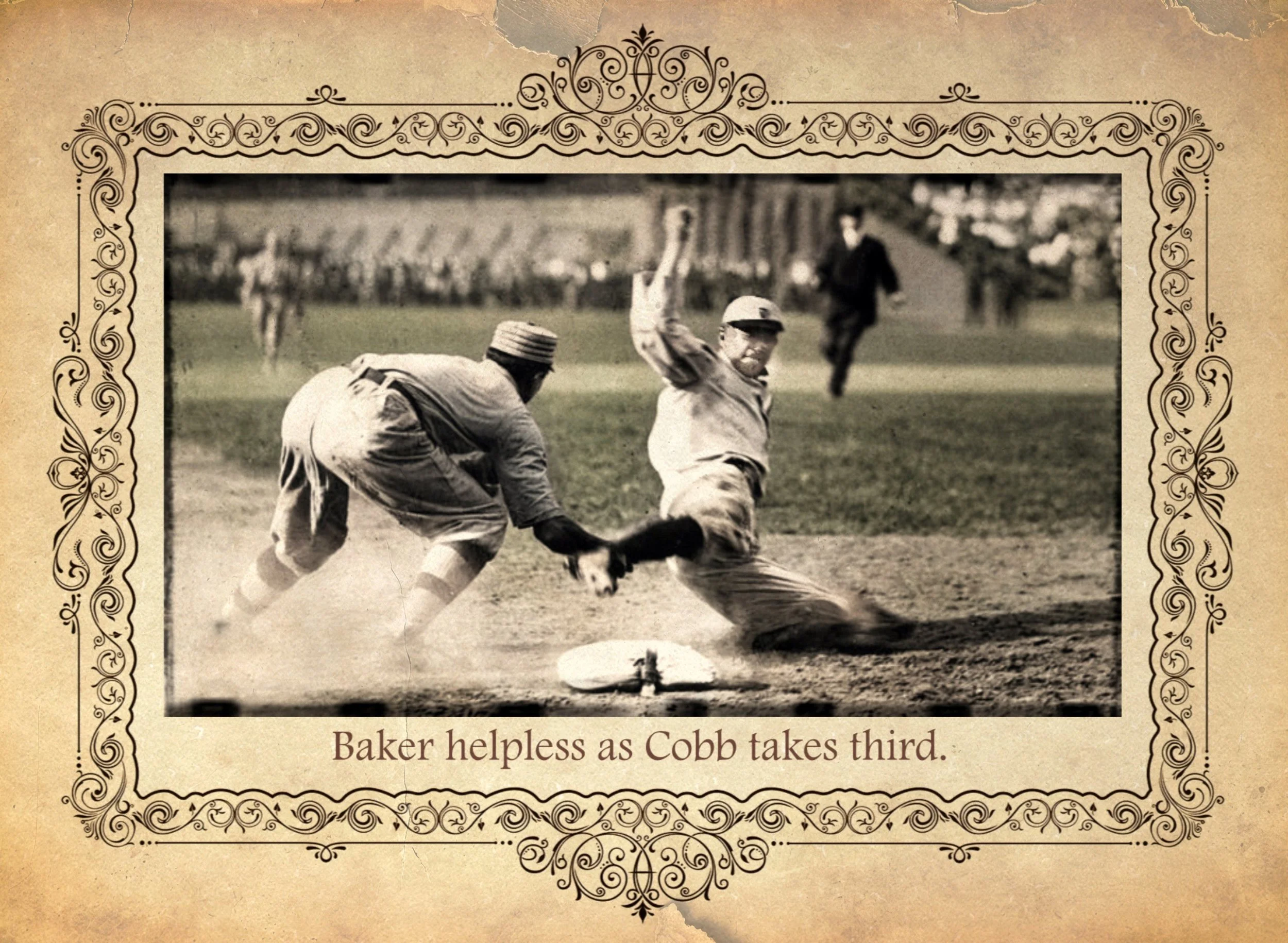
The incomparable Ty Cobb with his spikes high. The actual reason he came in high was to knock the ball out of the fielder’s glove—not to harm. One of the many myths surrounding him.